Police Officer Salary in Ohio: $84,810 (2026)
Quick Answer:Across Ohio's 67 metropolitan areas, the average median police officer pay sits at $84,810/year heading into 2026 — a figure projected from 2025 BLS OEWS wage data for SOC 33-3051. Because Ohio sits at BEA RPP 90.7 (9% below the U.S. baseline), that statewide median translates to roughly $93,506 in nationally-comparable purchasing power. Highest-paying metros: Columbus ($100,890), Cincinnati ($80,410), Cleveland ($80,280).
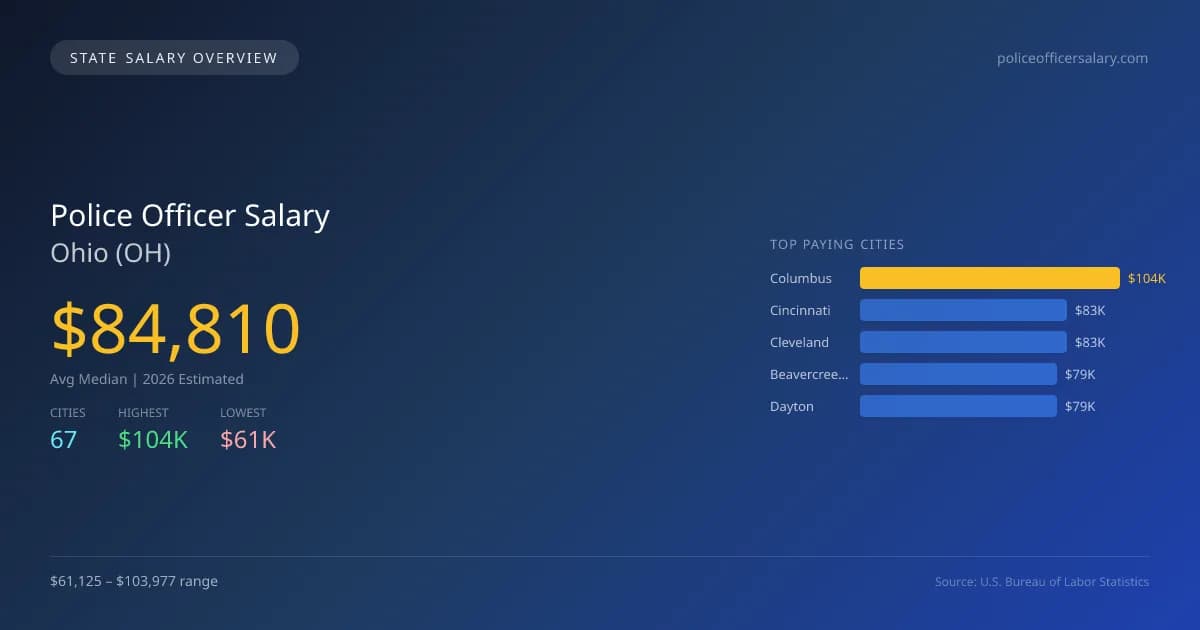
The projected average median salary for police officers in Ohio in 2026 is $84,809, which is 8.0% higher than the national median of $78,542. In terms of pay, Columbus leads the state significantly with an average salary of $103,977, while Youngstown offers the lowest at $61,125, illustrating a notable gap of $42,852. Factors contributing to this disparity include cost of living, departmental funding, and local crime rates, which can influence salary structures across different cities. To become a police officer in Ohio, candidates must meet state licensing requirements that include completing a basic training program and passing the Ohio Peace Officer Training Academy standards. The state's laws and regulations affect the scope of practice, and the demand for officers can be driven by population size, crime trends, and community needs. Looking ahead, the job market for police officers in Ohio shows a growth rate of 3.06% annually, reflecting a steady demand for law enforcement personnel. The projected salaries across major cities—in Columbus at $103,977, Cincinnati at $82,871, Cleveland at $82,737, Beavercreek at $78,768, and Dayton at $78,645—suggest various opportunities for career growth while reinforcing the importance of local conditions on compensation.
Ohio Police Officer Salary Range
Overall salary range in Ohio: $37,330 (lowest entry-level) to $120,008 (highest top earner)
Ohio vs National Average
Ohio police officers earn 7.98% more than the national median (+$6,268/year difference).
Ohio Police Officer Salary Distribution (2026)
Police Officer salaries in Ohio range from $57,165 (entry-level, 10th percentile) to $99,809 (top earners, 90th percentile), with a median of $84,810. The Ohio median is $6,268 above the US national median of $78,542. The average hourly rate is $40.77/hr. Approximately 21,137 police officers are employed across 67 cities.
2019 BLS Actual
$67,357
2025 BLS Actual
$82,291
2026 Current Est.
$84,810
2019–2027 Growth
+29.8%
Salary Trajectory for Police Officers in Ohio (2019–2027)
2019–2025: actual BLS OEWS data for this metro area. 2026+: CAGR 3.06% projection.
| Year | Annual Salary | Status |
|---|---|---|
| 2019 | $67,357 | Actual |
| 2020 | $69,820 | Actual |
| 2021 | $72,863 | Actual |
| 2022 | $72,874 | Actual |
| 2023 | $78,586 | Actual |
| 2024 | $81,995 | Actual |
| 2025 | $82,291 | Actual |
| 2026(current) | $84,810 | Estimated |
| 2027 | $87,405 | Projected |
Based on 7 years of BLS OEWS data for the Ohio metropolitan area, the median police officer salary grew 22.2% from $67,357 (2019) to $82,291 (2025). At a 3.06% compound annual growth rate, salaries are projected to reach $87,405 by 2027 — a total increase of $20,048 (29.76%) from 2019.
Note: Historical values (2019–2025) are actual BLS OEWS figures for the Ohio metropolitan area, sourced from annual Occupational Employment and Wage Statistics surveys. 2026–2026 figures are current estimates, and 2027 values are projections, calculated using a 3.06% CAGR derived from 7-year BLS historical data. Actual salaries may vary based on employer, experience, certifications, and local market conditions.
Top 5 Highest Paying Cities in Ohio
Lowest Paying Cities in Ohio
| City | Median Salary |
|---|---|
| Youngstown | $61,125 |
| Warren | $61,274 |
| Mansfield | $61,383 |
| Lima | $64,072 |
| Springfield | $65,051 |
Best Value Cities for Police Officers in Ohio
When adjusted for local cost of living, these Ohio cities offer the most purchasing power for police officers.
| City | Nominal Salary | CoL Index | Adjusted Salary |
|---|---|---|---|
| Columbus | $103,977 | 95.469 | $108,912 |
| Cleveland | $82,737 | 93.923 | $88,090 |
| Cincinnati | $82,871 | 95.37 | $86,894 |
| Beavercreek | $78,768 | 90.7 | $86,845 |
| Kettering | $77,585 | 90.7 | $85,540 |
Adjusted salary = nominal salary × (100 / CoL index). CoL index: 100 = national average. Lower index = lower cost of living.
Salary by Experience Level in Ohio
| Experience Level | Estimated Annual |
|---|---|
| Entry Level (0-2 years) | $57,165 |
| Mid Career (3-7 years) | $84,810 |
| Experienced (7+ years) | $99,809 |
Estimates based on BLS percentile data averaged across Ohio metro areas. Individual pay varies by employer, certifications, and specialization.
All 67 Cities in Ohio
| # | City | Median Salary |
|---|---|---|
| 1 | Columbus | $103,977 |
| 2 | Cincinnati | $82,871 |
| 3 | Cleveland | $82,737 |
| 4 | Beavercreek | $78,768 |
| 5 | Dayton | $78,645 |
| 6 | Kettering | $77,585 |
| 7 | Akron | $76,934 |
| 8 | Toledo | $75,904 |
| 9 | Lorain | $75,108 |
| 10 | Parma | $74,902 |
| 11 | Cuyahoga Falls | $74,596 |
| 12 | Hamilton | $74,337 |
| 13 | Lakewood | $73,931 |
| 14 | Bowling Green | $73,833 |
| 15 | Lancaster | $73,810 |
| 16 | Zanesville | $73,804 |
| 17 | Westlake | $73,678 |
| 18 | Middletown | $73,649 |
| 19 | Grove City | $73,435 |
| 20 | Delaware | $73,378 |
| 21 | Gahanna | $73,365 |
| 22 | Westerville | $73,320 |
| 23 | Huber Heights | $73,147 |
| 24 | North Ridgeville | $73,089 |
| 25 | North Royalton | $72,985 |
| 26 | North Olmsted | $72,725 |
| 27 | Sandusky | $72,709 |
| 28 | Reynoldsburg | $72,599 |
| 29 | Strongsville | $72,356 |
| 30 | Brunswick | $71,907 |
| 31 | Wooster | $71,907 |
| 32 | Elyria | $71,795 |
| 33 | Shaker Heights | $71,649 |
| 34 | Medina | $71,601 |
| 35 | Dublin | $71,371 |
| 36 | Fairfield | $71,365 |
| 37 | Mentor | $71,290 |
| 38 | Mason | $70,978 |
| 39 | Avon | $70,890 |
| 40 | Marion | $70,783 |
| 41 | Stow | $70,776 |
| 42 | Newark | $70,736 |
| 43 | Findlay | $70,661 |
| 44 | Green | $70,552 |
| 45 | Barberton | $70,552 |
| 46 | Austintown | $70,523 |
| 47 | Cleveland Heights | $70,512 |
| 48 | Upper Arlington | $70,419 |
| 49 | Xenia | $70,419 |
| 50 | Hilliard | $70,333 |
| 51 | Oxford | $70,114 |
| 52 | Chillicothe | $69,962 |
| 53 | Perrysburg | $69,706 |
| 54 | Trotwood | $69,683 |
| 55 | Athens | $68,945 |
| 56 | Tiffin | $68,560 |
| 57 | Wadsworth | $68,504 |
| 58 | Avon Lake | $68,453 |
| 59 | Centerville | $68,303 |
| 60 | Solon | $68,292 |
| 61 | Canton | $66,309 |
| 62 | Massillon | $65,410 |
| 63 | Springfield | $65,051 |
| 64 | Lima | $64,072 |
| 65 | Mansfield | $61,383 |
| 66 | Warren | $61,274 |
| 67 | Youngstown | $61,125 |
More Ohio Salary Data
Senior / Experienced
Top earner salaries for experienced police officers.
Compare Cities in Ohio
View all comparisons →Explore More Police Officer Salary Data
Frequently Asked Questions
How much do police officers make in Ohio in 2026?
What is the highest paying city for police officers in Ohio?
How does Ohio police officer pay compare to the national average?
What is the entry-level police officer salary in Ohio?
How many police officers are employed in Ohio?
Which Ohio city offers the best value for police officers?
Written by Jordan Lee, BA Criminal Justice
Career Analyst
Jordan Lee has over 10 years of experience in law enforcement. They specialize in community policing strategies. Jordan works with a municipal police department.
Methodology & Data Source
Statewide salary figures on this page are 2026 projections based on the Bureau of Labor Statistics Occupational Employment and Wage Statistics (OEWS) survey, May 2026 release. A 3.06% compound annual growth rate (CAGR), derived from 6-year national BLS wage trends, was applied to each metro area's reported salary to estimate current 2026 police officer compensation across Ohio. State averages are employment-weighted across 67 metro areas — larger metro areas with more police officerscontribute proportionally more to the average, producing figures that better reflect typical compensation. Individual pay varies by city, employer, certifications, and experience.
Data Sources & Methodology
Source: BLS, OEWS, 7-year dataset (–). Per-city data from annual BLS metropolitan area surveys.
2026 figures are projected from 2025 BLS data using a compound annual growth rate (CAGR) of 3.06%, derived from historical BLS wage trends for police officers (SOC 33-3051).
Compiled and verified by Jordan Lee, BA Criminal Justice, a licensed police officer with 10+ years of clinical experience. · View source data at BLS.gov